
Lot n° 170
Estimation :
6000 - 8000
EUR
Result without fees
Result
: 21 000EUR
Job BERCKHEYDE (1630-1693) - Lot 170
Job BERCKHEYDE (1630-1693)
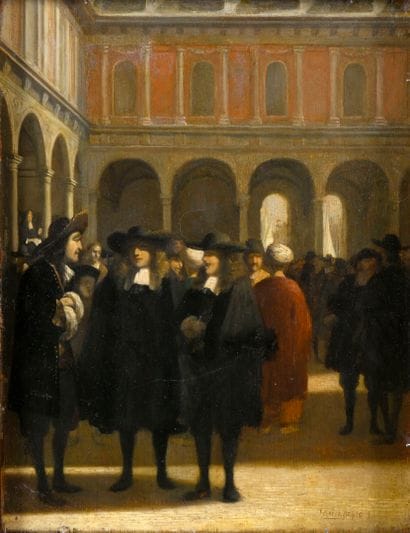
Traders in the courtyard of the Amsterdam Stock Exchange, after the renovation of 1668
Single-plank oak panel, not parqueted.
H. 24 cm - W. 18.3 cm ET
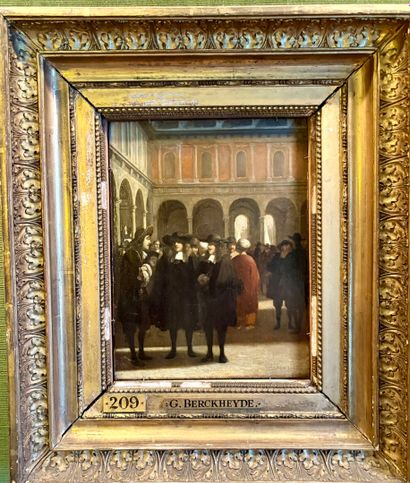
Late 18th-century wood and gilded stucco frame (with a N° 209).
Signed (raised signature) lower right.
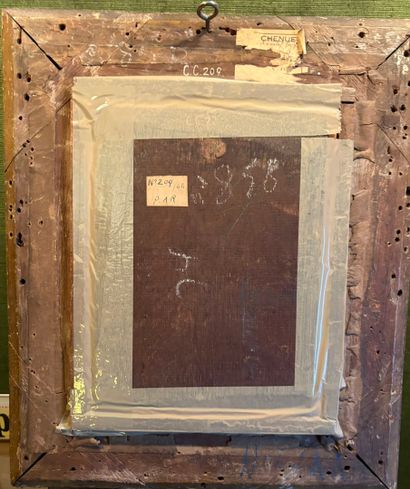
On the back, label N°209/G8 / P.A.R.
Provenance :
- Collection of Sir Frederick Cook, Doughty House, Richmond (at least until 1946, according to an annotation in the margin of a copy of the collection catalog, Internet Archive).
- Catalog of paintings from Doughty House, Richmond, and other collections of Sir Frederick Cook, reproduced under no. 209.
- Exhibited at the Guildhall Art Gallery in 1895 (no. 105).
Job BERCKHEYDE painted several pictures of the new Amsterdam stock exchange after its completion in 1668.
These include the painting in the collection of the Boyemans Van Beuningen Museum, Rotterdam (canvas 85 x 105 cm), the Städel Museum, Frankfurt (canvas 62.2 x 52.8 cm), and the Rijksmuseum, Amsterdam (canvas 89 x 116 cm).
Here, the artist favors a small format, highlighting the players on the stock exchange rather than the building itself. The figures depicted were intended to be easily recognizable by their contemporaries. In Amsterdam, the stock exchange building (the "Beurs"), originally designed by Hendrick de KEYSER and built around 1608-1611 to house merchant activities, underwent a major renovation in 1668. The architect in charge of this transformation, Daniël STALPAERT, proposed a project consisting mainly in modifying the façade overlooking the Rokin, by merging the two south porch pavilions into a single architectural body in the classical style. This extension met a growing need: in the mid-17th century, Amsterdam was experiencing intense commercial activity, both in goods trading and in securities transactions. The stock exchange therefore had to adapt to a denser flow of merchants, intermediaries and negotiations. One of the outstanding visual elements of the renovation was the integration of a statue of Mercury (god of commerce) by Bartholomeus EGGERS, placed between the two arches of the new porch, as a symbol of merchant activity and prosperity. The 1668 transformation not only modernized the building, but also reinforced its role as Amsterdam's vital center of trade and the stock exchange, marking a key stage in the evolution of places of exchange and market in Europe.
My orders
Sale information
Sales conditions
Return to catalogue
